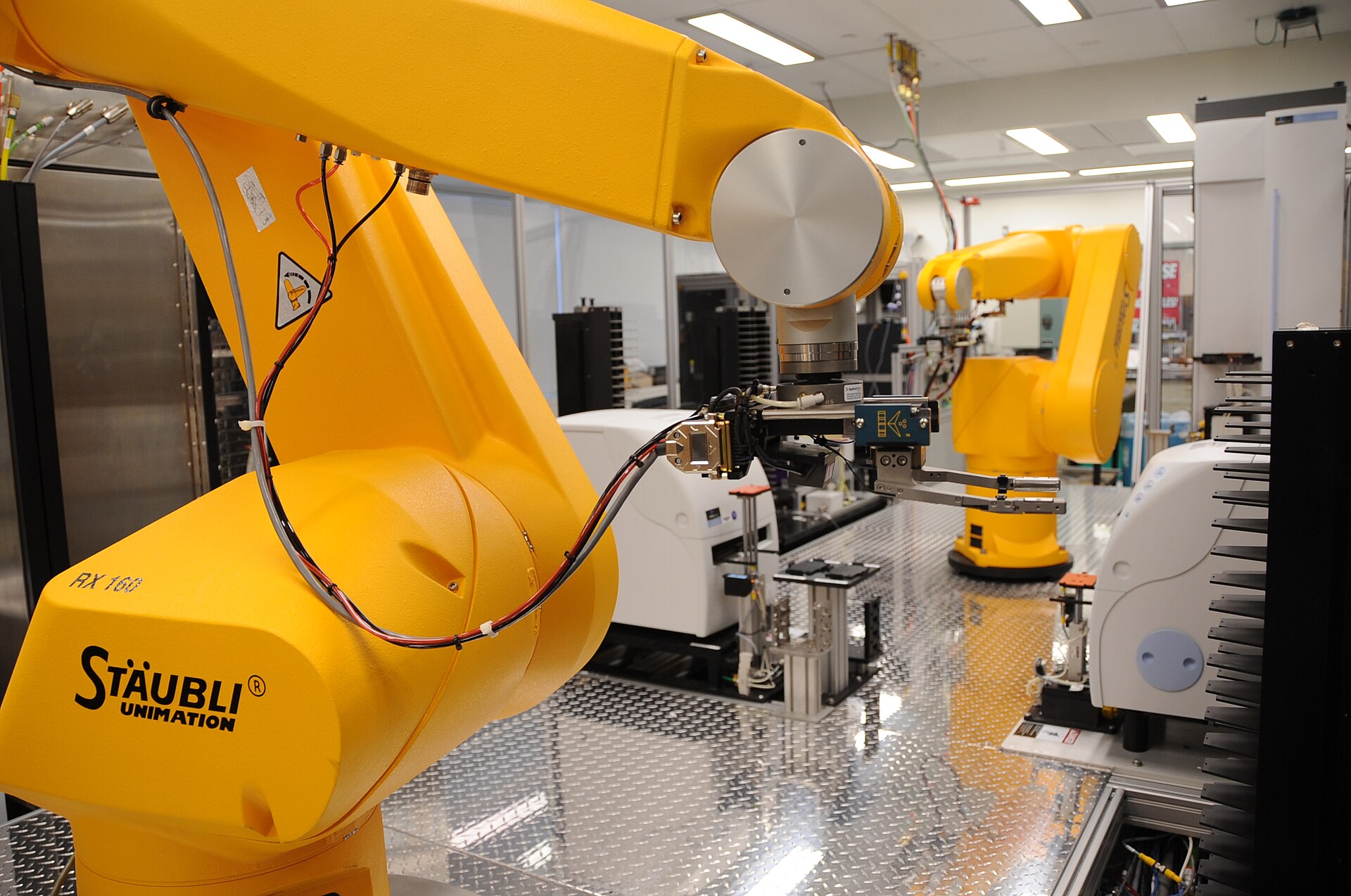
A robot that carries a plate across a laboratory is performing a recognisable engineering task: grip an object, move to a location and release it accurately. The biology happens through the work surrounding that movement. Liquids must reach the correct compartments, samples must keep their identities and measurements must remain connected to the conditions that produced them.
Understanding these separate jobs makes laboratory automation easier to follow. A fast arm is only one component of a useful system. The interesting question is how mechanical movement, liquid handling and information management combine to produce a result someone can interpret.
A microplate is an addressable arrangement of small containers
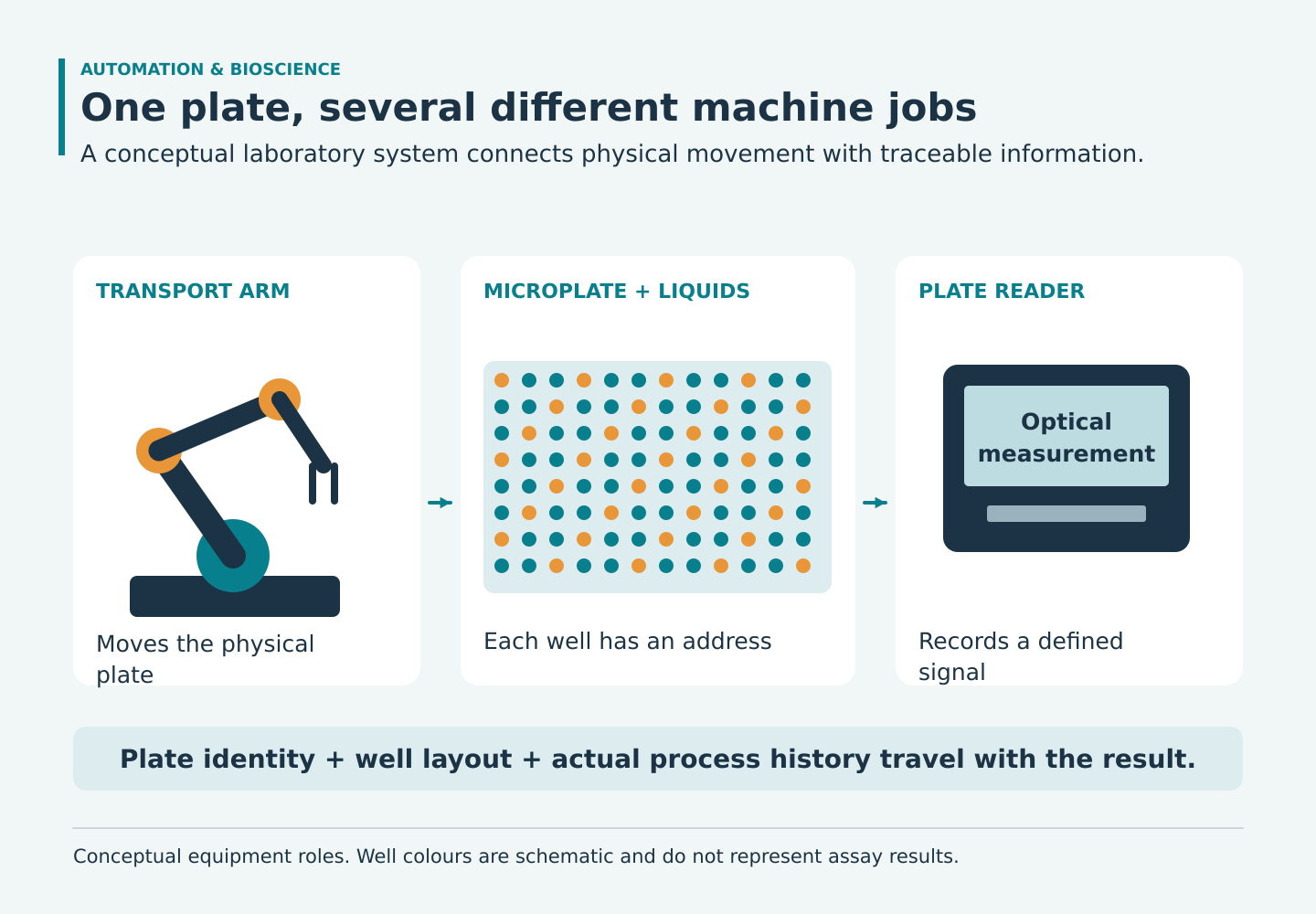
A microplate contains a regular grid of wells. Instead of treating the plate as one sample, a laboratory can assign different samples or conditions to individual positions. The row and column become an address: a result belongs to a particular well, on a particular plate, in a particular experiment.
For an engineering analogy, imagine a tray of numbered parts. Moving the tray correctly does not establish that every part has the correct specification. Likewise, a plate can arrive at its destination while its contents or recorded layout are wrong. The physical object and the information describing it must travel together.
The robot arm and the liquid handler have different jobs
A transport arm moves objects between stations. A liquid handler transfers or dispenses liquids. A plate reader measures a signal. Storage units, incubators and other instruments provide additional functions when the experiment requires them. These components may be integrated, but their responsibilities remain distinguishable.
The NIH National Center for Advancing Translational Sciences describes its automation systems as combinations of plate-transport robots, liquid-handling instruments, readers and controlled storage. It also describes software that monitors operations and retains process histories. That is a useful real example of automation as an organised workflow rather than an isolated robot.
When looking at a system diagram, label the action at each station. “Carries the plate,” “adds a liquid” and “records a signal” explain more than repeatedly writing “automated.” They also show where a delay or incorrect instruction could affect the experiment.
A reader turns a physical signal into a recorded value
Many plate-based experiments produce a measurable optical signal. Depending on the assay, the reader might record light absorbed, fluorescent light emitted after excitation or light generated by a chemical reaction. The instrument’s number becomes meaningful only when the experiment connects that signal to a defined question.
A bright well does not automatically mean a useful biological effect. It might be an expected control, a response from the sample or interference with the detection method. The reader records what its measurement system can detect; interpreting that record requires the assay design.
Follow one fictional plate through the system
| Stage | Physical job | Information that must remain attached |
|---|---|---|
| Registration | A labelled plate enters the workflow. | Plate identifier and planned well layout. |
| Liquid handling | Specified liquids are transferred. | Source positions and intended destinations. |
| Waiting period | The plate remains in a defined setting. | Actual start, finish and relevant conditions. |
| Reading | The instrument measures a signal. | Reader settings and the matching well addresses. |
| Review | Results are checked against controls. | Exceptions, exclusions and the analysis version. |
This is a conceptual example, not a laboratory protocol. Its purpose is to show why finishing the mechanical sequence does not finish the scientific work. The final record must explain both what happened and what the measurements represent.
Sample identity is a separate engineering problem
Consider two identical-looking plates with different contents. A robot may grip either one perfectly. If the system associates the wrong layout with the plate, every subsequent calculation can look orderly while answering the wrong question.
The NCATS compound-management description connects chemical registration, databases, storage, retrieval and distribution into vials or plates. That relationship explains why sample management belongs beside mechanics in a discussion of laboratory automation. A chemical’s identity is not carried by the appearance of its container.
A useful record therefore distinguishes an object’s location from the identity of its contents. “Plate in position three” is a location. “Plate containing this registered set of samples” is an identity claim. Both may be needed, and one should not silently replace the other.
Throughput and useful throughput can differ
Suppose a fictional demonstration moves twelve plates in an hour. That observation says something about movement under those demonstrated conditions. It does not establish that twelve complete experiments were prepared, measured and reviewed during the same hour.
Now imagine that a reader takes longer than the transfer step, or that some plates must wait before measurement. The slowest necessary part of the workflow can limit overall completion. Adding a second transport arm would not automatically resolve a reader bottleneck.
For the same reason, report the unit beside a productivity claim: plates moved, wells measured, samples processed or results accepted after review. These are related counts, but they are not interchangeable. An impressive number becomes more informative when its boundary is visible.
Repetition makes exceptions worth recording
Automation can repeat a specified action consistently. It can also repeat a mistaken instruction consistently. A skipped transfer, changed plate layout or interrupted run therefore needs an explicit record rather than an assumption that the system corrected itself.
Imagine that a fictional run pauses between dispensing and reading. The useful question is which plates were affected and whether their timing still fits the experiment. A vague note saying “robot restarted” would not supply that information.
Exception handling is part of the workflow’s meaning. It allows a later reader to distinguish a completed observation from a reconstructed assumption. A smooth demonstration video rarely shows all of that work, even though the quality of the result depends on it.
Why this matters for peptide research
Peptides can appear in laboratory workflows as materials being measured, samples being compared or molecules tested in a biological assay. The same separation of jobs applies: moving a container does not verify its contents, and measuring an assay signal does not establish a clinical benefit.
A useful starting vocabulary is therefore simple: sample, address, transfer, measurement and interpretation. Once those pieces are clear, more specialised topics such as peptide synthesis, chromatography and cell-based screening become easier to understand without giving a robot capabilities that belong to the entire research process.