Welcome to FastBrick Robotics!

At FastBrick Robotics, we’re revolutionizing the construction industry with our cutting-edge robotic technology. Our state-of-the-art robotic systems are designed to streamline the construction process, making it faster, safer, and more efficient than ever before.

With a commitment to innovation and excellence, we’re leading the way in automated construction solutions. Whether you’re a developer, contractor, or architect, our robotic systems are tailored to meet your specific needs and deliver exceptional results.

Explore our website to learn more about our groundbreaking technology, discover our range of robotic systems, and see how FastBrick Robotics can transform your construction projects.

About FastBrick Robotics

FastBrick Robotics is a leading provider of robotic construction solutions, dedicated to revolutionizing the way buildings are constructed. Our team of experts combines cutting-edge technology with years of industry experience to deliver innovative, efficient, and cost-effective solutions to our clients worldwide.

Founded in 2002, FastBrick Robotics has quickly established itself as a pioneer in the field of automated construction. With a focus on quality, reliability, and customer satisfaction, we’re committed to pushing the boundaries of what’s possible in construction technology.

At FastBrick Robotics, we believe that the future of construction is robotic. Join us in shaping the future of the industry and experience the power of automation with FastBrick Robotics.

Our Technology

At FastBrick Robotics, we leverage the latest advancements in robotics, artificial intelligence, and automation to develop innovative construction solutions that redefine the way buildings are constructed. Our proprietary robotic systems are designed to optimize every aspect of the construction process, from laying bricks to finishing touches.

Key features of our technology include:

  1. Robotic Bricklaying: Our robotic systems can lay bricks with precision and speed, significantly reducing construction time and labor costs.
  2. AI-Assisted Planning: Our AI algorithms analyze building plans and optimize construction sequences to minimize waste and maximize efficiency.
  3. Remote Monitoring: With real-time monitoring capabilities, project managers can track progress, identify issues, and make adjustments on the fly, ensuring projects stay on schedule and within budget.
  4. Safety: Our robotic systems are equipped with advanced safety features to protect workers and minimize the risk of accidents on the job site.

Discover the full range of capabilities of our technology and see how FastBrick Robotics is revolutionizing the construction industry.

Our Solutions

FastBrick Robotics offers a range of robotic construction solutions designed to meet the diverse needs of our clients. Whether you’re building a residential development, a commercial complex, or an industrial facility, our robotic systems can help you achieve your goals faster, safer, and more efficiently.

Our solutions include:

  1. FastBrick 1000: Our flagship robotic bricklaying system, capable of laying up to 1,000 bricks per hour with unmatched precision and accuracy.
  2. FastPlaster: An automated plastering system that streamlines the finishing process, delivering smooth, uniform finishes in a fraction of the time of traditional methods.
  3. FastInspect: A robotic inspection system that uses advanced sensors and imaging technology to identify defects and ensure quality control throughout the construction process.
  4. Custom Solutions: In addition to our standard offerings, we also provide custom robotic solutions tailored to the unique requirements of our clients’ projects.

Explore our solutions in more detail and discover how FastBrick Robotics can help you build better, faster, and smarter.

Contact Us

Ready to revolutionize your construction projects with FastBrick Robotics? Get in touch with our team today to learn more about our technology, discuss your project requirements, and request a consultation.

Our Blog

  • How Laboratory Robots Use Pipettes, Plates and Readers

    A robot that carries a plate across a laboratory is performing a recognisable engineering task: grip an object, move to a location and release it accurately. The biology happens through the work surrounding that movement. Liquids must reach the correct compartments, samples must keep their identities and measurements must remain connected to the conditions that produced them.

    Understanding these separate jobs makes laboratory automation easier to follow. A fast arm is only one component of a useful system. The interesting question is how mechanical movement, liquid handling and information management combine to produce a result someone can interpret.

    A microplate is an addressable arrangement of small containers

    A microplate contains a regular grid of wells. Instead of treating the plate as one sample, a laboratory can assign different samples or conditions to individual positions. The row and column become an address: a result belongs to a particular well, on a particular plate, in a particular experiment.

    For an engineering analogy, imagine a tray of numbered parts. Moving the tray correctly does not establish that every part has the correct specification. Likewise, a plate can arrive at its destination while its contents or recorded layout are wrong. The physical object and the information describing it must travel together.

    The robot arm and the liquid handler have different jobs

    A transport arm moves objects between stations. A liquid handler transfers or dispenses liquids. A plate reader measures a signal. Storage units, incubators and other instruments provide additional functions when the experiment requires them. These components may be integrated, but their responsibilities remain distinguishable.

    The NIH National Center for Advancing Translational Sciences describes its automation systems as combinations of plate-transport robots, liquid-handling instruments, readers and controlled storage. It also describes software that monitors operations and retains process histories. That is a useful real example of automation as an organised workflow rather than an isolated robot.

    When looking at a system diagram, label the action at each station. “Carries the plate,” “adds a liquid” and “records a signal” explain more than repeatedly writing “automated.” They also show where a delay or incorrect instruction could affect the experiment.
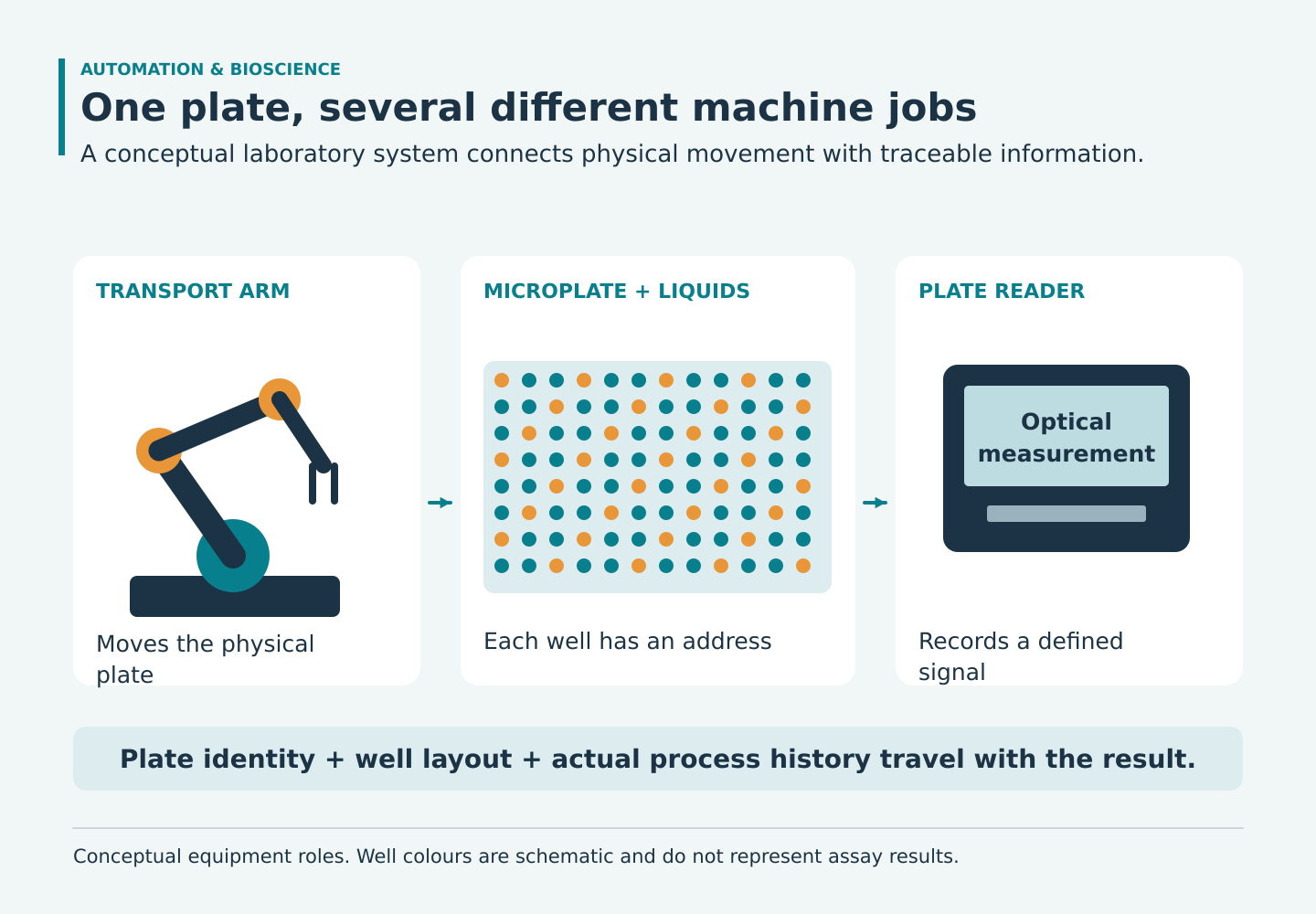
    A transport arm, microplate grid and reader show separate tasks, with sample identity and process history retained across the workflow.
    Moving a plate, adding liquids and interpreting a measurement are distinct jobs within one system. Image credits.

    A reader turns a physical signal into a recorded value

    Many plate-based experiments produce a measurable optical signal. Depending on the assay, the reader might record light absorbed, fluorescent light emitted after excitation or light generated by a chemical reaction. The instrument’s number becomes meaningful only when the experiment connects that signal to a defined question.

    A bright well does not automatically mean a useful biological effect. It might be an expected control, a response from the sample or interference with the detection method. The reader records what its measurement system can detect; interpreting that record requires the assay design.

    Follow one fictional plate through the system

    An invented workflow for understanding the roles of different stations
    StagePhysical jobInformation that must remain attached
    RegistrationA labelled plate enters the workflow.Plate identifier and planned well layout.
    Liquid handlingSpecified liquids are transferred.Source positions and intended destinations.
    Waiting periodThe plate remains in a defined setting.Actual start, finish and relevant conditions.
    ReadingThe instrument measures a signal.Reader settings and the matching well addresses.
    ReviewResults are checked against controls.Exceptions, exclusions and the analysis version.

    This is a conceptual example, not a laboratory protocol. Its purpose is to show why finishing the mechanical sequence does not finish the scientific work. The final record must explain both what happened and what the measurements represent.

    Sample identity is a separate engineering problem

    Consider two identical-looking plates with different contents. A robot may grip either one perfectly. If the system associates the wrong layout with the plate, every subsequent calculation can look orderly while answering the wrong question.

    The NCATS compound-management description connects chemical registration, databases, storage, retrieval and distribution into vials or plates. That relationship explains why sample management belongs beside mechanics in a discussion of laboratory automation. A chemical’s identity is not carried by the appearance of its container.

    A useful record therefore distinguishes an object’s location from the identity of its contents. “Plate in position three” is a location. “Plate containing this registered set of samples” is an identity claim. Both may be needed, and one should not silently replace the other.

    Throughput and useful throughput can differ

    Suppose a fictional demonstration moves twelve plates in an hour. That observation says something about movement under those demonstrated conditions. It does not establish that twelve complete experiments were prepared, measured and reviewed during the same hour.

    Now imagine that a reader takes longer than the transfer step, or that some plates must wait before measurement. The slowest necessary part of the workflow can limit overall completion. Adding a second transport arm would not automatically resolve a reader bottleneck.

    For the same reason, report the unit beside a productivity claim: plates moved, wells measured, samples processed or results accepted after review. These are related counts, but they are not interchangeable. An impressive number becomes more informative when its boundary is visible.

    Repetition makes exceptions worth recording

    Automation can repeat a specified action consistently. It can also repeat a mistaken instruction consistently. A skipped transfer, changed plate layout or interrupted run therefore needs an explicit record rather than an assumption that the system corrected itself.

    Imagine that a fictional run pauses between dispensing and reading. The useful question is which plates were affected and whether their timing still fits the experiment. A vague note saying “robot restarted” would not supply that information.

    Exception handling is part of the workflow’s meaning. It allows a later reader to distinguish a completed observation from a reconstructed assumption. A smooth demonstration video rarely shows all of that work, even though the quality of the result depends on it.

    Why this matters for peptide research

    Peptides can appear in laboratory workflows as materials being measured, samples being compared or molecules tested in a biological assay. The same separation of jobs applies: moving a container does not verify its contents, and measuring an assay signal does not establish a clinical benefit.

    A useful starting vocabulary is therefore simple: sample, address, transfer, measurement and interpretation. Once those pieces are clear, more specialised topics such as peptide synthesis, chromatography and cell-based screening become easier to understand without giving a robot capabilities that belong to the entire research process.


  • The Robotic Revolution: Transforming Manufacturing with Anavar

    In modern manufacturing, achieving precision, efficiency, and reliability is key to meeting the growing demands of various industries. Robotics has become a groundbreaking solution, automating complex processes and ensuring consistent quality across production lines. This innovation is particularly valuable in the pharmaceutical sector, where advanced technologies are used to produce anabolic steroids like aquatest for sale, ensuring high standards and reliable results for consumers.

    Anavar for sale, scientifically termed Oxandrolone, is a synthetic steroid that has gained popularity for its ability to promote muscle growth and enhance athletic performance. With a growing demand for pharmaceutical-grade Anavar, manufacturers face the challenge of producing it efficiently while adhering to stringent quality standards. This is where robotics step in to streamline the production process.

    Robots bring a multitude of advantages to the manufacturing of Anavar, enhancing various stages of production:

    1. Precision and Accuracy: One of the primary benefits of robotics is their unparalleled precision. In the synthesis of pharmaceuticals like Anavar, where precise measurements and controlled conditions are crucial, robots excel. They can handle delicate procedures with accuracy down to the micrometer, ensuring consistency in product quality batch after batch.
    2. Speed and Efficiency: Robots work tirelessly without fatigue or breaks, significantly accelerating the production process. They can perform repetitive tasks with lightning-fast speed, reducing cycle times and increasing overall output. This increased efficiency translates to cost savings for manufacturers and shorter lead times for consumers.
    3. Safety and Compliance: Ensuring the safety of both workers and consumers is paramount in pharmaceutical manufacturing. Robots can handle hazardous materials and operate in sterile environments without risking contamination. By minimizing human involvement in critical processes, they reduce the likelihood of errors and ensure compliance with strict regulatory standards. This is particularly crucial when considering the risks associated with compounds like trenbolone side effects, highlighting the need for precision and control in steroid manufacturing.
    4. Flexibility and Adaptability: Modern robotic systems are highly flexible and adaptable, capable of performing a wide range of tasks with minimal reprogramming. In the dynamic pharmaceutical industry, where formulations and production requirements may change rapidly, this flexibility is invaluable. Robots can seamlessly switch between different tasks, allowing manufacturers to respond swiftly to market demands.
    5. Data-driven Insights: Robotics integrated with advanced sensors and analytics provide invaluable data insights throughout the production process. From monitoring temperature and pressure to analyzing chemical reactions in real-time, robots generate vast amounts of data that manufacturers can leverage for process optimization and quality control.
    6. Sustainability: Robotics play a vital role in driving sustainability initiatives within manufacturing. By optimizing resource utilization and minimizing waste, they help reduce the environmental footprint of Anavar production. Additionally, their energy-efficient operation contributes to lower energy consumption and greenhouse gas emissions.

    Despite these numerous benefits, the integration of robotics into pharmaceutical manufacturing, including Anavar production, is not without its challenges. Initial investment costs can be significant, and specialized expertise is required for programming and maintenance. Furthermore, ensuring seamless integration with existing manufacturing processes requires careful planning and execution.

    However, the long-term advantages far outweigh these challenges. By harnessing the power of robotics, manufacturers can achieve unprecedented levels of efficiency, precision, and safety in Anavar production. Ultimately, this translates to higher-quality products, increased competitiveness, and improved accessibility for those who rely on Anavar for medical or performance-enhancing purposes.

    In conclusion, the synergy between robotics and manufacturing has ushered in a new era of efficiency and innovation. As technology continues to evolve, so too will the capabilities of robotic systems, further enhancing the production of pharmaceuticals like Anavar. Embracing this robotic revolution is not just a choice but a necessity for manufacturers striving to stay ahead in an increasingly competitive global market.


Join the future of construction with FastBrick Robotics. Let’s build something amazing together.